rufino q. jimenez

PhD Research

The Ethics of Entropy: a practice-research PhD in systems aesthetics and systems theory at Goldsmiths, University of London, begun in January 2026. Everything made during the doctorate lands here.

The Ethics of Entropy2026 · browser-based interactive work · filmed tour, two minutes The research vault as a hyperbolic node map. The map itself is not published online; it is shown in person.

Statement

My work bridges non-equilibrium thermodynamics and systems aesthetics to build a living architecture for art. In the doctorate it takes the form of an interactive digital map: more than two thousand atomic ideas from my research, mapped onto a hyperbolic disk and run as a thermodynamics, with a drawn schematic beside it carrying the mathematics. What I am attempting is a standard model of systems aesthetics, the pattern beneath the patterns. As Descartes found one geometry beneath every figure by giving space coordinates, I am looking for the common architecture beneath every system that persists: the property that emerges wherever matter, life, or thought organises against a gradient, and that feeds into everything else, from ecology to economics to cognition to art itself.

The framework begins with three givens. The speed of light is also the speed of causality. Because that speed is constant for every observer, time itself becomes relative; what stays invariant is the order in which causes can reach effects. That invariant order is the system all events must follow, and therefore all systems, which are made of events. Entropy gives the order its direction. And physics itself supplies the third given, the long ambition running from Newton's unifications to the standard model and the search beyond it, that there is an underlying structure to everything. Together they ground the claim at the centre of my work: systems are an emergent property of entropy moving through causality. Whatever persists, persists by circulating, holding its shape through the small, continuous adjustments that meet its gradient; what fails to meet it collapses and reorganises, locally or across scales. Here it is enough to watch how systems hold, fall, and reorganise.

My work is with systems, and systems show us how truth obeys physics. A truth is a dissipative structure that exists within a convection of validation. It holds its shape by processing the new through itself; sealed away from that flow, it stills into dogma, which cannot prove itself from within.

This is one architecture surfacing across disciplines. Gödel proved that no formal system can demonstrate its own consistency from within; Hume showed that no account of what is can, on its own, yield what ought to be. Truth held in the convection of validation, the incompleteness of formal systems, and the gap Hume's guillotine cuts all share the same shape: every system that persists requires an outside to complete it. For the formal system that outside is an axiom it cannot prove; for the is, an ought it cannot derive; for a truth, the validation it cannot give itself, which arrives through use, construction, and form.

Beneath the mapping is the reason for it. To see how systems hold, fall, and reorganise is to see what our will does when it enters them. The framework is an architecture for realising the implications of our actions on the system dynamics we live inside: ethics as diagnosis, and as the small adjustments that steer a severed circulation back toward its gradient.

The map itself is not a closed archive but a living research boundary, reorganising as returns arrive from an outside reality of matter, ideas, mathematics, and other minds. I work in the lineage of systems aesthetics: Jack Burnham's turn from objects to the relations that produce them, and Agnes Denes, who mapped her philosophy graphically and re-projected the world onto new geometries, making art about systems and from them. The schematic continues Denes's gesture. It is this statement drawn as the system it describes, and this statement is itself part of that system: as practice research it performs what it argues, validating and contextualising the art as art, situating the work within a schema. Your reading completes the circuit, attention entering the work as validation and placing it, from outside, within the boundary of art.

What you are looking at

Every point of light is one atomic idea from the research: a claim, a source, an operator, a piece of evidence, a mechanism, a question or a definition. Every line is a typed relation between two of them. The map is built from the vault directly, 2,232 nodes and 6,970 relations at the current build, and it changes when the research changes: a new argument opens new sources at the rim, a settled one deepens towards the centre, and a failed one folds its own region of the disk.

The space is hyperbolic, a Poincaré disk. The most-connected operators sit near the centre; specific claims and evidence fan out to the rim, which is infinitely far from every node. Inward is towards the core; outward is towards its particulars. The most-connected node in the map, the one the geometry places nearest the centre, is the convection of validation.

The energy overlay, in the framework's own terms

Exergy enters at the sources. Source material is stored information, potential: it enters as usable free energy and flows downstream into the claims that cite it. Read through a schema, it converts into what is accepted, which fuels the framework, and what is left open.

Anergy pools at open questions. It can still convert, at an adjacent system's boundary conditions rather than inside its own: anergy downstreams and becomes exergy in a neighbouring system, the way a question one field sets aside becomes the working premise of another. A dropped or stale concept is anergy gone cold, a terminal pool. A dispute pools anergy on the smooth surface and, like an open question, can still resolve at a conversion point or cross the fold.

Bridges reconvert it. Where a question reaches a bridge the change happens in thought: the anergy downstreams there and returns as exergy in a different system of ideas, flowing onward into new claims.

The fold has two outcomes. The cusp is a premise that reorganised through it, discharging new exergy onward; the catastrophe is a premise that could not recompose, collapsed into a void. When a claim is validated by data or philosophy at other scales, that validation returns to the core concepts it instantiates, the nested return: the convection of validation.

The framework

Entropy Circulation Topology reads persisting systems as circulations and distinguishes two shapes of conversion: a circulatory topology returns what it converts to the systems that sustain it; an extractive topology linearises the loop, takes the gradient, and leaves the cost to pool elsewhere. The ethics in the title is diagnostic: it asks where a circulation has been cut and what has been put in its place. The framework is operating on itself in the map, complete only to the edge of its own frame.
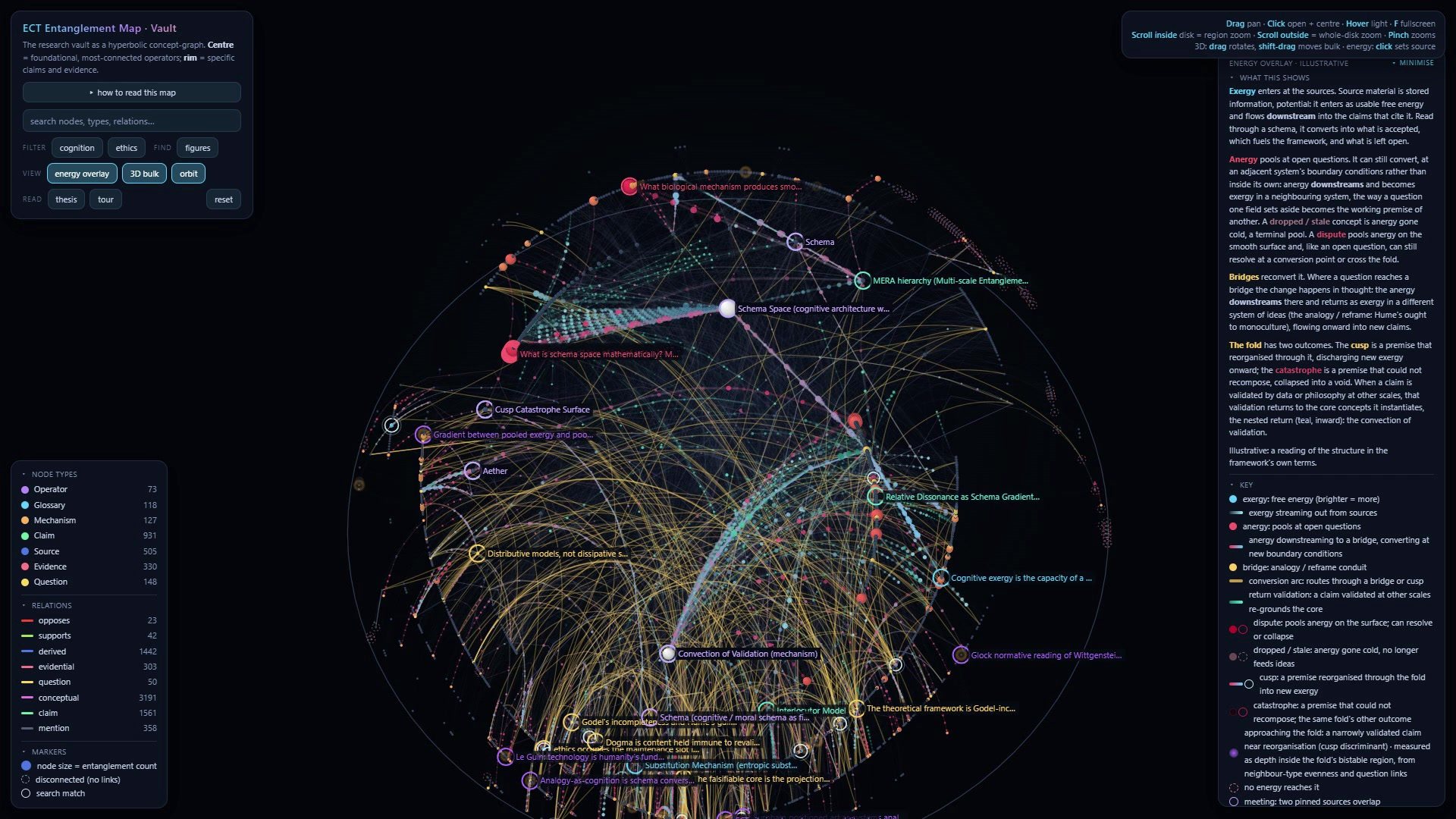
The Ethics of Entropy in energy overlay, seen as a three-dimensional bulk: coloured flows arc above the disk, the map's panels at each side
The Ethics of Entropy2026 · energy overlay, three-dimensional bulk The same structure read as a flow. Also shown as a work in Conceptual.
AAAWgmp1bWIAAAAeanVtZGMycGEAEQAQgAAAqgA4m3EDYzJwYQAAABZcanVtYgAAAEdqdW1kYzJtYQARABCAAACqADibcQN1cm46YzJwYTpkYTVmMjk4YS1kMzVkLTQ5NjQtOTA4Mi05YWY3NWQ2YWYxM2MAAAADl2p1bWIAAAApanVtZGMyYXMAEQAQgAAAqgA4m3EDYzJwYS5hc3NlcnRpb25zAAAAALxqdW1iAAAARGp1bWRjYm9yABEAEIAAAKoAOJtxE2MycGEuaW5ncmVkaWVudC52MwAAAAAYYzJzaFiyNuk37+GFHwlFqmgkZCcAAABwY2JvcqNpZGM6Zm9ybWF0bWltYWdlL3N2Zyt4bWxqaW5zdGFuY2VJRHgseG1wOmlpZDo1OWE5YTQzNy02ZjFlLTQ2MDYtYTk5ZC0wYjY0YWZlYzFiMTRscmVsYXRpb25zaGlwaHBhcmVudE9mAAAB4mp1bWIAAABBanVtZGNib3IAEQAQgAAAqgA4m3ETYzJwYS5hY3Rpb25zLnYyAAAAABhjMnNoTK31qieeZheAtkQ2RwFI6QAAAZljYm9yomdhY3Rpb25zgqJmYWN0aW9ua2MycGEub3BlbmVkanBhcmFtZXRlcnOha2luZ3JlZGllbnRzgaJjdXJseC1zZWxmI2p1bWJmPWMycGEuYXNzZXJ0aW9ucy9jMnBhLmluZ3JlZGllbnQudjNkaGFzaFggsgt5egIM73Cf/vc+TTcK7vDBvmccc+XPfaZAfolPrrGkZmFjdGlvbngdY29tLmFudGhyb3BpYy5jbGF1ZGUucHJvdmlkZWRqcGFyYW1ldGVyc6F4H2NvbS5hbnRocm9waWMub3JpZ2luLWNvbmZpZGVuY2VndW5rbm93bmtkZXNjcmlwdGlvbnhmQ2xhdWRlIHByb3ZpZGVkIHRoaXMgZmlsZSBhdCB0aGUgcmVxdWVzdCBvZiBhIHVzZXIgYW5kIG1heSBoYXZlIGNyZWF0ZWQgb3IgbW9kaWZpZWQgdGhlIGZpbGUgY29udGVudHMubXNvZnR3YXJlQWdlbnShZG5hbWVmQ2xhdWRlcmFsbEFjdGlvbnNJbmNsdWRlZPUAAADIanVtYgAAAEBqdW1kY2JvcgARABCAAACqADibcRNjMnBhLmhhc2guZGF0YQAAAAAYYzJzaJyijnglA3y+EJ7EN+W6tnoAAACAY2JvcqVjYWxnZnNoYTI1NmNwYWRMAAAAAAAAAAAAAAAAZGhhc2hYINQf5H56bt9oQGCNT2DhV1DI5dQBEpbIQQh1kR2OPQFAZG5hbWVuanVtYmYgbWFuaWZlc3RqZXhjbHVzaW9uc4GiZXN0YXJ0GQOIZmxlbmd0aBkeBAAAAj5qdW1iAAAAJ2p1bWRjMmNsABEAEIAAAKoAOJtxA2MycGEuY2xhaW0udjIAAAACD2Nib3KlY2FsZ2ZzaGEyNTZpc2lnbmF0dXJleE1zZWxmI2p1bWJmPS9jMnBhL3VybjpjMnBhOmRhNWYyOThhLWQzNWQtNDk2NC05MDgyLTlhZjc1ZDZhZjEzYy9jMnBhLnNpZ25hdHVyZWppbnN0YW5jZUlEeCx4bXA6aWlkOjNmNmMyZTk0LTY3MjAtNDAxYy05ZGU1LTA5ZTJmYzVkMmQ3YXJjcmVhdGVkX2Fzc2VydGlvbnODomN1cmx4LXNlbGYjanVtYmY9YzJwYS5hc3NlcnRpb25zL2MycGEuaW5ncmVkaWVudC52M2RoYXNoWCCyC3l6AgzvcJ/+9z5NNwru8MG+Zxxz5c99pkB+iU+usaJjdXJseCpzZWxmI2p1bWJmPWMycGEuYXNzZXJ0aW9ucy9jMnBhLmFjdGlvbnMudjJkaGFzaFggN2v6d831xg4eIj3UqkLCQcgqxmt1jdMZwIXxwOJrfUOiY3VybHgpc2VsZiNqdW1iZj1jMnBhLmFzc2VydGlvbnMvYzJwYS5oYXNoLmRhdGFkaGFzaFggXXRqjbmA9G+pqd8FQ+pGHzU8GvKO6Z45C61J6IveXwV0Y2xhaW1fZ2VuZXJhdG9yX2luZm+jZG5hbWVvQW50aHJvcGljIEZpbGVzZ3ZlcnNpb25lMS4wLjBrc3BlY1ZlcnNpb25lMi40LjAAABA4anVtYgAAAChqdW1kYzJjcwARABCAAACqADibcQNjMnBhLnNpZ25hdHVyZQAAABAIY2JvctKEWQISogEmGCFZAgowggIGMIIBjaADAgECAhRA5aAK7sI50L64g/oGQgU9Z1UTADAKBggqhkjOPQQDAzBJMRcwFQYDVQQKEw5BbnRocm9waWMsIFBCQzEuMCwGA1UEAxMlQW50aHJvcGljIENvbnRlbnQgQ3JlZGVudGlhbHMgUm9vdCBDQTAeFw0yNjA4MDcxODQzNTZaFw0yODA4MDYxOTQzNTZaMEQxFzAVBgNVBAoTDkFudGhyb3BpYywgUEJDMSkwJwYDVQQDEyBBbnRocm9waWMgQ2xhdWRlIENvbnRlbnQgU2lnbmluZzBZMBMGByqGSM49AgEGCCqGSM49AwEHA0IABJh6CmvLUBgFFNU0vUKlOVtE6djd17L5SuwX0LemFisBM3dkd/3cyjxFA3Qo5S46fX0/ihY0VZ7mfb9KF703t5OjWDBWMA4GA1UdDwEB/wQEAwIHgDAVBgNVHSUEDjAMBgorBgEEAYPoXgIBMAwGA1UdEwEB/wQCMAAwHwYDVR0jBBgwFoAUzlHiBIFOZFsj+OPEz5o+nMHXXMIwCgYIKoZIzj0EAwMDZwAwZAIwMXMdFJ4BetLLVY7ORuE9noqbbAZOZn/aArXyTwFAZfKrPzxF2vPoJNf1+UCdg1XGAjBwX1zd9WGqYkqmL5SFqw1QySjr1zJfpJM9+1rdDwSPLMOPOjKuiXjoU/pUUeG9RwmhY3BhZFkNngAAAAAAAAAAAAAAAAAAAAAAAAAAAAAAAAAAAAAAAAAAAAAAAAAAAAAAAAAAAAAAAAAAAAAAAAAAAAAAAAAAAAAAAAAAAAAAAAAAAAAAAAAAAAAAAAAAAAAAAAAAAAAAAAAAAAAAAAAAAAAAAAAAAAAAAAAAAAAAAAAAAAAAAAAAAAAAAAAAAAAAAAAAAAAAAAAAAAAAAAAAAAAAAAAAAAAAAAAAAAAAAAAAAAAAAAAAAAAAAAAAAAAAAAAAAAAAAAAAAAAAAAAAAAAAAAAAAAAAAAAAAAAAAAAAAAAAAAAAAAAAAAAAAAAAAAAAAAAAAAAAAAAAAAAAAAAAAAAAAAAAAAAAAAAAAAAAAAAAAAAAAAAAAAAAAAAAAAAAAAAAAAAAAAAAAAAAAAAAAAAAAAAAAAAAAAAAAAAAAAAAAAAAAAAAAAAAAAAAAAAAAAAAAAAAAAAAAAAAAAAAAAAAAAAAAAAAAAAAAAAAAAAAAAAAAAAAAAAAAAAAAAAAAAAAAAAAAAAAAAAAAAAAAAAAAAAAAAAAAAAAAAAAAAAAAAAAAAAAAAAAAAAAAAAAAAAAAAAAAAAAAAAAAAAAAAAAAAAAAAAAAAAAAAAAAAAAAAAAAAAAAAAAAAAAAAAAAAAAAAAAAAAAAAAAAAAAAAAAAAAAAAAAAAAAAAAAAAAAAAAAAAAAAAAAAAAAAAAAAAAAAAAAAAAAAAAAAAAAAAAAAAAAAAAAAAAAAAAAAAAAAAAAAAAAAAAAAAAAAAAAAAAAAAAAAAAAAAAAAAAAAAAAAAAAAAAAAAAAAAAAAAAAAAAAAAAAAAAAAAAAAAAAAAAAAAAAAAAAAAAAAAAAAAAAAAAAAAAAAAAAAAAAAAAAAAAAAAAAAAAAAAAAAAAAAAAAAAAAAAAAAAAAAAAAAAAAAAAAAAAAAAAAAAAAAAAAAAAAAAAAAAAAAAAAAAAAAAAAAAAAAAAAAAAAAAAAAAAAAAAAAAAAAAAAAAAAAAAAAAAAAAAAAAAAAAAAAAAAAAAAAAAAAAAAAAAAAAAAAAAAAAAAAAAAAAAAAAAAAAAAAAAAAAAAAAAAAAAAAAAAAAAAAAAAAAAAAAAAAAAAAAAAAAAAAAAAAAAAAAAAAAAAAAAAAAAAAAAAAAAAAAAAAAAAAAAAAAAAAAAAAAAAAAAAAAAAAAAAAAAAAAAAAAAAAAAAAAAAAAAAAAAAAAAAAAAAAAAAAAAAAAAAAAAAAAAAAAAAAAAAAAAAAAAAAAAAAAAAAAAAAAAAAAAAAAAAAAAAAAAAAAAAAAAAAAAAAAAAAAAAAAAAAAAAAAAAAAAAAAAAAAAAAAAAAAAAAAAAAAAAAAAAAAAAAAAAAAAAAAAAAAAAAAAAAAAAAAAAAAAAAAAAAAAAAAAAAAAAAAAAAAAAAAAAAAAAAAAAAAAAAAAAAAAAAAAAAAAAAAAAAAAAAAAAAAAAAAAAAAAAAAAAAAAAAAAAAAAAAAAAAAAAAAAAAAAAAAAAAAAAAAAAAAAAAAAAAAAAAAAAAAAAAAAAAAAAAAAAAAAAAAAAAAAAAAAAAAAAAAAAAAAAAAAAAAAAAAAAAAAAAAAAAAAAAAAAAAAAAAAAAAAAAAAAAAAAAAAAAAAAAAAAAAAAAAAAAAAAAAAAAAAAAAAAAAAAAAAAAAAAAAAAAAAAAAAAAAAAAAAAAAAAAAAAAAAAAAAAAAAAAAAAAAAAAAAAAAAAAAAAAAAAAAAAAAAAAAAAAAAAAAAAAAAAAAAAAAAAAAAAAAAAAAAAAAAAAAAAAAAAAAAAAAAAAAAAAAAAAAAAAAAAAAAAAAAAAAAAAAAAAAAAAAAAAAAAAAAAAAAAAAAAAAAAAAAAAAAAAAAAAAAAAAAAAAAAAAAAAAAAAAAAAAAAAAAAAAAAAAAAAAAAAAAAAAAAAAAAAAAAAAAAAAAAAAAAAAAAAAAAAAAAAAAAAAAAAAAAAAAAAAAAAAAAAAAAAAAAAAAAAAAAAAAAAAAAAAAAAAAAAAAAAAAAAAAAAAAAAAAAAAAAAAAAAAAAAAAAAAAAAAAAAAAAAAAAAAAAAAAAAAAAAAAAAAAAAAAAAAAAAAAAAAAAAAAAAAAAAAAAAAAAAAAAAAAAAAAAAAAAAAAAAAAAAAAAAAAAAAAAAAAAAAAAAAAAAAAAAAAAAAAAAAAAAAAAAAAAAAAAAAAAAAAAAAAAAAAAAAAAAAAAAAAAAAAAAAAAAAAAAAAAAAAAAAAAAAAAAAAAAAAAAAAAAAAAAAAAAAAAAAAAAAAAAAAAAAAAAAAAAAAAAAAAAAAAAAAAAAAAAAAAAAAAAAAAAAAAAAAAAAAAAAAAAAAAAAAAAAAAAAAAAAAAAAAAAAAAAAAAAAAAAAAAAAAAAAAAAAAAAAAAAAAAAAAAAAAAAAAAAAAAAAAAAAAAAAAAAAAAAAAAAAAAAAAAAAAAAAAAAAAAAAAAAAAAAAAAAAAAAAAAAAAAAAAAAAAAAAAAAAAAAAAAAAAAAAAAAAAAAAAAAAAAAAAAAAAAAAAAAAAAAAAAAAAAAAAAAAAAAAAAAAAAAAAAAAAAAAAAAAAAAAAAAAAAAAAAAAAAAAAAAAAAAAAAAAAAAAAAAAAAAAAAAAAAAAAAAAAAAAAAAAAAAAAAAAAAAAAAAAAAAAAAAAAAAAAAAAAAAAAAAAAAAAAAAAAAAAAAAAAAAAAAAAAAAAAAAAAAAAAAAAAAAAAAAAAAAAAAAAAAAAAAAAAAAAAAAAAAAAAAAAAAAAAAAAAAAAAAAAAAAAAAAAAAAAAAAAAAAAAAAAAAAAAAAAAAAAAAAAAAAAAAAAAAAAAAAAAAAAAAAAAAAAAAAAAAAAAAAAAAAAAAAAAAAAAAAAAAAAAAAAAAAAAAAAAAAAAAAAAAAAAAAAAAAAAAAAAAAAAAAAAAAAAAAAAAAAAAAAAAAAAAAAAAAAAAAAAAAAAAAAAAAAAAAAAAAAAAAAAAAAAAAAAAAAAAAAAAAAAAAAAAAAAAAAAAAAAAAAAAAAAAAAAAAAAAAAAAAAAAAAAAAAAAAAAAAAAAAAAAAAAAAAAAAAAAAAAAAAAAAAAAAAAAAAAAAAAAAAAAAAAAAAAAAAAAAAAAAAAAAAAAAAAAAAAAAAAAAAAAAAAAAAAAAAAAAAAAAAAAAAAAAAAAAAAAAAAAAAAAAAAAAAAAAAAAAAAAAAAAAAAAAAAAAAAAAAAAAAAAAAAAAAAAAAAAAAAAAAAAAAAAAAAAAAAAAAAAAAAAAAAAAAAAAAAAAAAAAAAAAAAAAAAAAAAAAAAAAAAAAAAAAAAAAAAAAAAAAAAAAAAAAAAAAAAAAAAAAAAAAAAAAAAAAAAAAAAAAAAAAAAAAAAAAAAAAAAAAAAAAAAAAAAAAAAAAAAAAAAAAAAAAAAAAAAAAAAAAAAAAAAAAAAAAAAAAAAAAAAAAAAAAAAAAAAAAAAAAAAAAAAAAAAAAAAAAAAAAAAAAAAAAAAAAAAAAAAAAAAAAAAAAAAAAAAAAAAAAAAAAAAAAAAAAAAAAAAAAAAAAAAAAAAAAAAAAAAAAAAAAAAAAAAAAAAAAAAAAAAAAAAAAAAAAAAAAAAAAAAAAAAAAAAAAAAAAAAAAAAAAAAAAAAAAAAAAAAAAAAAAAAAAAAAAAAAAAAAAAAAAAAAAAAAAAAAAAAAAAAAAAAAAAAAAAAAAAAAAAAAAAAAAAAAAAAAAAAAAAAAAAAAAAAAAAAAAAAAAAAAAAAAAAAAAAAAAAAAAAAAAAAAAAAAAAAAAAAAAAAAAAAAAAAAAAAAAAAAAAAAAAAAAAAAAAAAAAAAAAAAAAAAAAAAAAAAAAAAAAAAAAAAAAAAAAAAAAAAAAAAAAAAAAAAAAAAAAAAAAAAAAAAAAAAAAAAAAAAAAAAAAAAAAAAAAAAAAAAAAAAAAAAAAAAAAAAAAAAAAAAAAAAAAAAAAAAAAAAAAAAAAAAAAAAAAAAAAAAAAAAAAAAAAAAAAAAAAAAAAAAAAAAAAAAAAAAAAAAAAAAAAAAAAAAAAAAAAAAAAAAAAAAAAAAAAAAAAAAAAAAAAAAAAAAAAAAAAAAAAAAAAAAAAAAAAAAAAAAAAAAAAAAAAAAAAAAAAAAAAAAAAAAAAAAAAAAAAAAAAAAAAAAAAAAAAAAAAAAAAAAAAAAAAAAAAAAAAAAAAAAAAAAAAAAAAAAAAAAAAAAAAAAAAAAAAAAAAAAAAAAAAAAAAAAAAAAAAAAAAAAAAAAAAAAAAAAAAAAAAAAAAAAAAAAAAAAAAAAAAAAAAAAAAAAAAAAAAAAAAAAAAAAAAAAAAAAAAAAAAAAAAAAAAAAAAAAAAAAAAAAAAAAAAAAAAAAAAAAAAAAAAAAAAAAAAAAAAAAAAAAAAAAAAAAAAAAAAAAAAAAAAAAAAAAAAAAAAAAAAAAAAAAAAAAAAAAAAAAAAAAAAAAAAAAAAAAAAAAAAAAAAAAAAAAAAAAAAAAAAAAAAAAAAAAAAAAAAAAAAAAAAAAAAAAAAAAAAAAAAAAAAAAAAAAAAAAAAAAAAAAAAAAAAAAAAAAAAAAAAAAAAAAAAAAAAAAAAAAAAAAAAAAAAAAAAAAAAAAAAAAAAAAAAAAAAAAAAAAAAAAAAAAAAAAAAAAAAAAAAAAAAAAAAAAAAAAAAAAAAAAAPZYQLotCSMCbvMxNKCAfXyPQYxeIyeC+M+Z/HizweRBNEbgnw/HGydQNDXha9JXkZLbIEoToYOCgLSA2ezh535uHQU= ARTIST STATEMENT SYSTEMS · ARCHITECTURE · AESTHETICS — DRAWN AS THE SYSTEM IT DESCRIBES I · GIVENS dS ≥ 0 the one direction no contact no contact reachable a path picks its way cone by cone ct x x = ±ct contact ⇔ ds² = c²dt² − |dx|² ≥ 0 light structures causality; entropy orients it II · THE FOLD V(x) = ¼x⁴ + ½ax² + bx the sheet: V′(x) = x³ + ax + b = 0 collapse, reorganise smooth sheet — small adjustments hold 4a³ + 27b² = 0 what reinforces itself is carried over the fold; collapse is reorganisation toward the gradient III · CIRCULATION exergy in — the gradient anergy out — exergy stripped in the descent Ex_destroyed = T₀·S_gen return — at another scale LINEARISE — cut the manifold to an actable line MEET AN OUTSIDE REALITY matter · ideas · mathematics · other minds THE WELL — the descent converts RE-GROUND r = r₀e^(−λθ) κ 0.2 ≤ κ ≤ 0.5 t → x(t) seen in time, circulation is oscillation the same circulation at every scale: cell · ecology · ethic κ, the circulation index — the fraction of flow that returns the well turns because the gradient passes through it — circulation is open, or it is not circulation; the descent strips exergy to anergy, and what returns, returns at another scale IV · THE CONVECTION OF VALIDATION Ra = gβΔT·d³ ⁄ (ν·α) — structure appears at Ra > Ra_c schema — it holds; it can hold dogma an outside reality — inexhaustible gradient of the new d the cells tile a claim, carried helically through the cell A ∝ e^(σt) incorporation agitation the truth is the structure itself, standing in the flow; the schema only holds — and a schema can hold dogma Ra_c = 27π⁴⁄4 ≈ 657.5 conduction — dogma the cell holds breakdown — see II a truth holds its shape by the convection of validation — agitation, the friction of the new, at the boundary; incorporation into the schema. sealed below onset it is dogma (F ⊬ Cons F); overdriven, it breaks and reorganises dogma Ra < Ra_c — the gradient conducts past; nothing stands. the only closed curve here V · THE BOUNDARY 1312 1261 207 1181 0 the researcher its readers an outside reality claims out, for testing 2,037 ideas · 6,664 relations every claim carries its state of validation ds = 2|dz| ⁄ (1−|z|²) — the rim is infinitely far not a closed archive: a living research boundary, reorganising as the returns arrive u1 u6 VI · ETHICS ethics enters as diagnosis — the ought marks where a circulation has been severed — and as prosthesis: the small adjustments that steer it back toward the gradient Systems persist through circulation — the small adjustments by which a self-sustaining system meets its gradient; what fails to meet it collapses and reorganises until it does, locally or across scales. you, reading — validation entering at two scales: into the work, as part of its internal convection of validation — and onto its frame: the context that places it within art and systems aesthetics Statement drawn as the system it describes. Node positions and counts as in the running work (ECT Entanglement Map, 2026); layers at r = tanh(u·ln2⁄2). I · what may touch — II · Thom: how it falls — III · the open well — IV · truth as convection — V · the boundary — VI · ethics as diagnosis.
Artist Statement2026 · animated schematic, drawn in SVG and CSS · the schematic that stands beside the map The statement drawn as the system it describes, carrying the mathematics: causal structure and entropy feeding a circulation, the fold, the convection of validation, the boundary, and the reader entering from outside. On a desktop, rest the pointer on each panel: the motion is the mechanism. Open at full size.

Writing

Papers and talks from the doctorate. Coming soon.

Seeing the map

The map is shown in person. To see it, or to talk about the work, write to rufinoqjimenez@gmail.com or find me on LinkedIn.